About
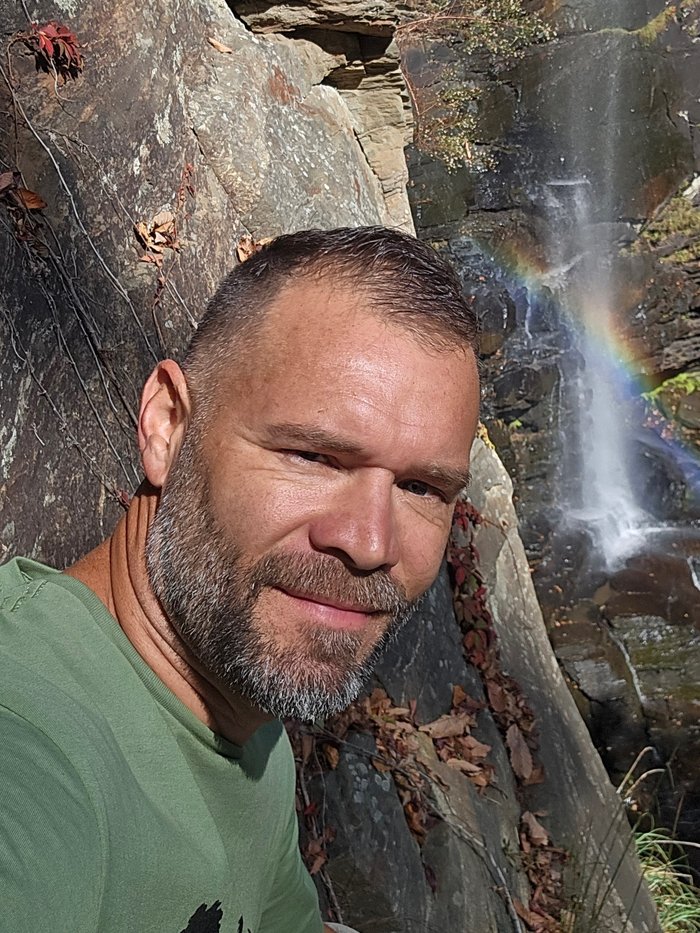
Elton Liles
25+ years turning properties into places people actually want to be outside, in his own words, below.
I've been doing this a long time. I've loved it even longer.
Some of my earliest memories of becoming interested in plants are with my granny.
We gardened together when I was growing up. I would bring home plants that caught my attention (often something we didn't know much about) and we'd figure them out together. We'd sit at the table with books, and later the early internet, learning what they were, how large they would grow, how much sun they needed and where they belonged.
She encouraged that curiosity. We'd go looking for interesting plants together, and as I got older I'd spend my own money on them.
I didn't know then that plants would become my life's work. I just knew I loved them.
I also grew up outdoors. I became an Eagle Scout, spent a tremendous amount of time in nature, and was artistic from the time I was a kid. Eventually those things came together.
I found my medium.
It just happened to be alive.
A landscape is living art.
I studied horticulture, but school wasn't what made me passionate about plants. That came from collecting them myself.
Once I began collecting seriously, I discovered this enormous world of plants I had never known existed: unusual Japanese maples, conifers, different forms, colors, textures and characteristics. The more I learned, the more I wanted to know.
More than 25 years later, that curiosity is still there.
It's also why I don't look at plants as something you add to a project after everything else has been built.
A plant is living material. It changes. It grows into the plants around it. It changes with the seasons. A tree that fits a space today may completely change the light underneath it ten years from now.
That's part of the art.
Stone is different. Water is different. Grade, drainage, structures and lighting each bring another dimension. When all of those things are considered together, you aren't just installing landscaping around a house.
You're creating a place.
That's what interests me.
I want to see what a property can become.
When I first walk a property, I'm looking at much more than what is already there.
I'm looking at the land. The architecture. The views from inside the house. Where your eye goes when you step outside. How people are going to move through the space. Where water naturally wants to travel. Where the sun falls. What should be revealed and what should disappear.
Sometimes I can see possibilities that aren't obvious yet.
I've climbed an excavator onto an enormous pile of soil and started carving shapes into it because I could see the beginnings of a garden. I've changed the direction of a waterfall during construction because I realized there was a better way for someone to experience it from their home. I've positioned trees knowing the shade they create years from now will be as important as how they look today.
That's why I have a hard time separating landscape design, horticulture and construction.
To me, they're the same project.
A beautiful design that can't be properly built isn't a successful design. Beautiful stonework surrounded by plants that don't belong there isn't a successful landscape. And a garden that photographs beautifully the week it's installed but doesn't work five or ten years later isn't good enough either.
I want the whole thing to work.
If it's not 100% right, it's 100% wrong.
That's a saying we use, and it probably tells you more about how I work than a long explanation of quality ever could.
It doesn't mean nature has to be perfect. Nature isn't perfect, and some of the most beautiful landscapes I've created are intentionally naturalistic.
It means our work has to be intentional.
If a stone doesn't sit right, we fix it.
If a plant isn't in the right place, we move it.
If the drainage isn't right, the fact that nobody will see it when we're finished doesn't make it less important.
If something can be done better, I want it done better.
I've worked on focused projects in the $20,000 range and complete landscapes approaching $2 million. The scale and complexity can change dramatically, but that standard doesn't.
People are trusting me with their homes, their money and a place they're going to live with for years. They deserve my best work.
And they deserve to understand what they're paying for.
Education has become a big part of the way I work with clients.
Most people don't build landscapes every day. I don't expect someone to know what proper drainage requires, why a particular plant belongs in one location instead of another, what it takes to construct a natural-looking waterfall, or why something that looks simple may require substantial work underneath it.
That's my responsibility to explain.
I'll tell you what I think your property needs. I'll also tell you what I don't think it needs.
If something isn't practical, I'll explain why. If an idea is going to cost more than you expect, I'd rather have that conversation early. If there's a better way to spend the money, we'll talk about it.
I want you to understand what we're doing, why we're doing it and what you're getting for your investment.
Because when a client understands the project, we can make better decisions together.
Everyone deserves a place they enjoy being outside.
The projects have gotten larger over the years. The equipment has gotten bigger. I've had the opportunity to work with extraordinary plants, move hundreds of tons of stone and create landscapes that I couldn't have imagined when I was a kid gardening with my granny.
But I don't think the reason I do it has changed very much.
I love being outside.
I love plants.
I love making things.
And there is still something captivating to me about creating with a material that's alive.
My own garden is full of plants I've collected and landscapes I've experimented with because this isn't something I stop thinking about when the workday ends. I get to watch those plants mature, see relationships develop that I imagined years earlier, learn from the things that worked and occasionally change the things that didn't.
Then I get to bring that experience to somebody else's property.
Whether that means one special part of a landscape or transforming an entire property, I believe people deserve an outdoor place that feels like theirs: a place that gives them a reason to walk outside, sit down and stay awhile.
If I can create that for somebody, I've done my job.
The recognition came afterward.
Along the way, my work has received horticultural, creative, environmental and Best in Show recognition at the Southern Spring Home & Garden Show, as well as recognition from Houzz. I've had opportunities to share what I've learned about plants and design through the MrMaple Show and SouthPark Magazine. I'm proud of those things, and the complete record belongs here for anyone who wants to know more.
But none of them are where this story started.
It started with a kid and his granny putting interesting plants in a garden, then sitting down together to learn what they'd just planted.
I'm still learning.
I'm still collecting.
And I'm still excited to see what the next piece of ground can become.
Elton Liles Plant Man
It's your day(dream). Live it.
Or call (704) 219-0160